The Importance of Empathy

There is a disorder called “congenital analgesia,” in which a person cannot can feel physical pain.

Imagine a world without pain. You wouldn’t have to deal with the tear-inducing consequences of stubbing your toe, and spicy foods wouldn’t bother you, even if you had a cold sore. Waxing would be a breeze. Hangnails and paper cuts wouldn’t phase you. You wouldn’t have to worry about getting cold. You’d also be an unstoppable boxer.

A painless world, in theory, sounds pretty appealing. Until you realize those with congenital analgesia will not feel the pain of a broken bone, or the searing burn of touching the wrong end of a curling iron. They will not feel the heat radiate from an infection on their skin. They can’t feel a cavity festering in their mouth, or the immediate sting of accidentally slicing a finger while chopping vegetables. Hypothermia could set in, and they wouldn’t feel a thing.

Even though pain is inconvenient as hell, a world without pain is wildly dangerous. Physical pain is critical to our survival: it serves the sole purpose to keep us safe by letting us know something is wrong. Physical pain is part of the human condition.

Emotional pain is also part of is part of the human condition.

But emotional pain is an entirely different kind of pain. This pain is the anguish that comes from losing a loved one; the emptiness of a breakup; the loneliness of depression. It’s the kind of pain that numbs you and breaks you at the same time, the kind that makes you feel like nothing will ever be the same.

However, those dealing with intense emotional pain are rarely met with the same open arms and compassion as those dealing with severe physical pain. Physical pain is so much easier to understand; it happens when something in the body isn’t working properly. We can look at these people through x-rays, examinations, blood tests, and highly-calibrated medical instruments to find the source of their pain. Once it’s found, they are treated, bandaged up and sent on their way–problem solved.

Emotional pain is so much harder to understand because emotional pain often results when our emotions are working correctly–when nothing is wrong. We experience the depths of grief because we have had genuine human connections. We mourn the end of relationships because we loved someone with all our heart. We know depression because we once knew happiness.

Emotions like worry, fear, and sadness are just as natural as happiness, joy, and love. All emotions are simply natural occurrences in a life fully lived. And yet, we as a human race, have such a distain for the half of our emotional spectrum that causes us emotional pain. We deem these emotions as negative, and rush to repress them and “get over it.” This is detrimental to us because it prolongs our healing. No emotion is good or bad–they are complex and nuanced can cannot be forced into the binary of “good” or “bad.” It’s not a crime to feel sadness, or anger, or annoyance, or aggravation. It’s human.

Our obsession with the “positive” side of our emotional range prevents us from feeling the full range of human emotions, and reaping all of the benefits that come with a complete emotional spectrum. It’s hard to accept, but we need all our emotions–every last one. Just as physical pain keeps us safe, emotional pain keeps us centered. How would we know if something in our life was making us unhappy, if we weren’t actually unhappy?

Since we tend to struggle with our own emotional pain, we’re often ill-equipped to help others’ with their emotional pain. We have a knee-jerk reaction to distance ourselves from another’s pain. We respond with phrases like “It will get better!” and “Just stay positive–you’ll get through this!” These phrases are for our own comfort; not the comfort of the person in pain. These phrases minimize and distance the pain from ourselves, reflecting it onto the one in need. Let’s be real–no one’s hurt was ever erased by a well-meaning, but poorly timed, “It will all work out!” I think the pervasiveness of these types of responses show how adverse we, as a culture, are to emotional pain, and how as a society, we often lack the emotional intelligence and the vocabulary for true empathy.

True empathy requires us to resist our instinct to avoid pain so we can put the well-being of a fellow human first, if only for a moment. It takes us acknowledging our discomfort with seeing others in pain, to see our own vulnerability in another. It takes true empathy to understand when we sit with someone in their pain, we are not being asked to make the pain go away, we are being asked to validate their feelings and share in their humanity. Sometimes, it doesn’t feel good to be human. And that’s okay.
Standards, Values, and Beliefs

This post is adapted from a private journal entry from October 2019.

It had been a particularly frustrating therapy session. I had come in feeling agitated about nothing in particular, just a general feeling of annoyance with my emotions that were running uncharacteristically high over the past few weeks. My therapist had noticed, and prompted me to discuss what was making me so unhappy recently.

“It’s everything and nothing all at the same time,” I said, exasperated. “Sometimes I feel like to make my life better I’d have to change it so drastically that it wouldn’t be my life anymore. And that scares me because I don’t know where to begin.”

“Wow, that’s some really black and white thinking,” my therapist said. She thought for a moment. “Have you ever heard of standards, values, and beliefs?”

I shook my head no.

Standards, values, and beliefs (we’ll call them SVBs for short) are the personal principles that we use to guide ourselves through our own lives. They act as our compass, and help lead us to people, experiences, and decisions that align with what we believe and value.

These definitions make more sense in the context of examples. Let’s say you value spending time with your friends. If this is your value, one of your beliefs might be that friends should spend time together. This belief could lead you to the standard that you and your friends prioritize seeing each other often, at least twice a month. Our SVBs all reinforce each other, and help define what matters most to us.

When our standards, values, or beliefs are tested, we can either chose to stand our ground, or modify them if there is enough of a reason change. Let’s use the previous example–your standard is you and your friends should see each other at least twice a month. That’s a great standard to have, but what happens when, for example, a few friends move away, or a friend gets a new job with less flexible hours, or everyone is struggling to juggle all their new adult obligations? You could choose to hold your ground, and insist that your friends all get together at least twice a month, which might be extremely difficult to coordinate. Or, you could choose to live your value of spending time with your friends by opting to go on a group trip planned well in advance, or take time to call your friends individually when you both have free time.

The beauty of standards, values, and beliefs are that they can be as flexible or stringent as we would like them to be. What determines one’s SVBs–along with the criteria it takes to change them–is completely up each individual. Only you can define, change, and enforce the values you choose to prioritize.

I have found the process of defining, modifying, and enforcing my standards, values, and beliefs to be one of the most satisfying, but also challenging experiences I’ve had this year. As I’m exploring my SVBs, I’m learning a lot about myself and what makes me me at my core. It’s fantastic, because I’m finally able to put into words what’s most important to me and see a clear path forward to creating the life I want to live. Once you know what truly matters to you, you can’t forget it. And since you can’t forget it, you have to face the big question: am I living my life in a way that’s inline with my values?

For me, the answer to that question was, “Eh, sorta.”

A lot of this past year has been feeling just “eh” about a lot of decisions and events in my life. I realized I was feeling so indifferent about them because I hadn’t taken the time to truly understand my standards, values, and beliefs. I was without my life’s compass, and I was totally lost.

My therapist had me write down my standards, values, and beliefs–no matter how important, or unimportant, or hyper-specific, or silly they were. It was empowering to be finally put words to the values I hadn’t ever spoken out loud, and to see what I believed in written on a page.

And now you get to see (some) of them typed on a screen:

I believe in...

  • Caring about others less fortunate than myself, even if I will never meet them
  • Seeing the best in others
  • No job, relationship, or pursuit should consume me to the point where it’s all I do
  • Reflecting often
  • Making an effort to stay healthy
  • Paying people a living wage
  • Striving to improve and being my best self
  • Work-life balance
  • Being kind to food service workers, no matter what
  • Speaking up if something is wrong
  • The power of a good hug
  • Not taking myself too seriously
  • The snooze button
  • Laughter
  • Friendships
  • Love
  • Honesty
  • Family

My standards are…

  • I keep my house (relatively) clean
  • Dishes should be done while you’re cooking, and NEVER left in the sink overnight
  • I am loving towards myself
  • I am forgiving to myself
  • I show everyone compassion and empathy
  • The people in my life will not look down on therapy
  • Never look down on others
  • Have genuine compassion for others
  • Honesty is the best policy
  • It’s okay to hit the snooze button a few times
  • Listen before speaking
  • My job should bring me fulfillment

I value…

  • Creativity
  • Intelligence
  • Compassion
  • Communication
  • Kindness
  • Empathy
  • Nature
  • Fitness
  • Willingness to be open and honest
  • Traveling and seeing the world
  • Understanding and appreciating others’ perspectives
  • Logic and rationality
  • Using reason, but still tapping into feelings
  • Honesty with the self
  • Honesty with others
  • Making this world a better place

There are so many more I could write and share, but for now, is plenty. This is what I’m comfortable sharing, because this is what I’m comfortable enforcing.

In the past, I’ve tended to falter when it came to enforcing some of my standards, because I feared what other’s would would think of them, or because I was afraid to carry out the consequences if someone violated them. Recently, I’ve been working on living my standards, values, and beliefs unapologetically, no matter what others think or feel about them. Because my values guide my life–and my life only.

The Self-Help Book Paradox

I love self help books. I buy a new one at least once a month, and add more to my Amazon reading list every week. I pour over their passages numerous times, circling and underlining and highlighting and starring all the wisdom and advice contained within their pages. Words cannot describe the euphoria of finding a passage that just so perfectly describes my current situation that it feels as if the self-help book author took it right from my own mind.

I’m drawn to self-help books so much because I love to learn, and I love being my best-self. But if I’m being honest, part of me is addicted to them. I have joked with my therapists and friends that I suffer from my own self-help book paradox: I read self-help books with the goal of improving myself, but before I ever put the book’s suggestions into action, I always find a new self-help book to read. These books give me the feeling that I’m working towards a better self, but in reality, they just allow me to live the illusion of self-improvement. As long as I’m armed with a self-help book, I don’t actually have to self-improve. They allow me to comfortably sit in perpetual self-reflection.

While this love of self-reflection is one of my greatest gifts, I began to use it as a crutch in 2019. I spent a significant part of this year analyzing my thoughts, motives, actions, successes, and failures ad nauseam. I’d claim that it was all to better myself, but in reality, it’s was just my way of putting off the process of letting go.

I tend to avoid letting go for the same reasons I keep an arsenal of self-help books on my dresser: it allows me to live in this limbo of all this self-reflection and self-improvement with none of the action it takes to actually move forward into something better.

For the past few days, I have tried to write a reflection on my 2019. But the harder I tried to write something impactful, the more frustrated I got. My 2019 was one of the best years of my life, but also one of the most challenging, and I wanted to wrap up my year with a thoughtful post that gave all 365 days their justice. But the more I wrote about 2019, the more I realized I had nothing left to say about it. I was trying to give my 2019 the self-help book treatment, and I was stuck spinning my wheels in self-reflection.

It’s time to let go. It’s time to move forward.

So instead of self-reflecting my entire 2019 to death, I’m letting go of all of it–including the pang of guilt I feel for letting it go. No more dissecting it, no more reliving it. I’m honoring my 2019 by promising myself not to say anything more about it. This last post of 2019 is me Marie Kondo‘ing this entire year. This is my vow to stop dwelling, and to put more energy into the work it takes to move into something better.

To my 2019:

Thank you for all the opportunities and lessons you gave me. Thank you for all the growth I had in my relationships with myself and with others. Thank you for this year of life.

And now that I’ve thanked you, I’m letting you go without any guilt. No more analyzing, reanalyzing, obsessing, or regretting. You happened, and now you’re over.

And with that, goodbye 2019.

The Miracle Question

It was one of my first therapy sessions, and I was spiraling.

I had worked myself up about everything that was frustrating me–my mood, my family, my job, my body, my mind, my depression, my anxiety, my lack of motivation, my loans….the list went on and on.

My therapist stopped me. “Have you ever heard of the miracle question?”

I was slouched in my chair, completely defeated. “No,” I sniffed, “What’s that?”

My therapist looked me straight in the eyes: “Olivia, let’s pretend I can perform a miracle. If you woke up tomorrow and everything in your life was fixed, and all your worries were gone, what would your life look like?”

Just thinking about the answer made me cry. Envisioning the life I could have, but currently didn’t, hurt me to my core. I was so far from where I wanted to be, and I felt like the work to get myself to the life I wanted would truly take nothing short of a miracle.

“Well,” I began, “I wouldn’t be depressed.”

“That’s a good start. Keep going.”

So I kept going. Miracle Me would have a stronger relationship with her parents; Miracle me would be a better daughter. Miracle Me would be working at a kick ass job, making kick-ass money. She’d be using every ounce of her creativity to be build an impactful and beautiful blog. She’d spend more time with her friends, she’d have her own place. And she wouldn’t have anxiety; she wouldn’t fear living out her values. Miracle Me would be living the life she wanted.

My therapist prompted me, “So why can’t you have that?”

“Because I’m not a miracle worker.”

My therapist pushed back. “Everything you listed is partly or completely under your control. You can be a better daughter, you could have that dream job and you will make that money. You are building your blog every week, and you have plans to move out. You’re in therapy; you’re not going to be depressed or anxious forever. We’re working through your hangups, and you’re getting all the skills you need to feel confident to actively participate in your life again. You don’t need a miracle.”

You don’t need a miracle.

I shifted in the purple armchair; all of the sudden I was really uncomfortable. A knot formed in my stomach, and my throat tightened. You don’t need a miracle.

I absolutely didn’t need a miracle; but I craved one. If a miracle was the only thing that would fix my life, then I could sit back and let my life happen to me, because only divine intervention or some wild twist of fate could fix everything that wrong. No amount of actions, therapy, money, or writing could ever change my life if I needed a miracle. But I didn’t need a miracle. I just wanted off the hook for playing a major role in perpetuating my unhappiness.

I told my therapist what I was thinking. “It’s easier to just blame the universe than actually admit I’m causing a lot more of my problems than I thought. It’s really hard admitting I could fix my life; that I’m the only one standing in my way.”

“Well good news,” my therapist said with enthusiasm, “we’re going to teach you how to get out of your own way. Therapy is already getting you back on the right track–you’re going to get to the life you want.”

So if you you feel like your life isn’t what you want, and you think you need a miracle, you actually might just need a talented therapist.

Psychological Bitch Slaps

It did not take me more than two sessions to tell my therapist about my (previously) pitiful excuse of a blog.

Telling her about this blog felt like a confession. Here I am, seeking therapy to help me improve my mental health, while I have a blog about mental health that has sat–quite literally–untouched for almost a year because my mental health was weighing me down. How mortifying.

When I told my therapist about all my lofty dreams I had for my future self and this blog, she told me, “Well you can’t get there unless you start!” To which I replied, “My first–and only–blog post is called “A to B” and it’s all about how I am paralyzed just by starting. I want to be there already. The irony of it all is not lost on me.” And my therapist simply said back, “Well you can’t get there without starting! So you just have to find a way to start. You have to hold yourself accountable.”

Well, duh.

90% of therapy is being told what you, deep down, already know. I obviously knew I had to just write something–anything–to continue working on the blog. But for the past eleven months I could not bring myself to do it. I came up with excuse after excuse. Too tired, too depressed, too anxious, too busy. I’m not in the right mood. What if people read all this and judge me? What if no one reads it and I’m just shouting into an internet void? But my therapist was right–I was refusing to hold myself accountable.

And even though the fix for my inaction was so simple–to literally write anything–I still could not bring myself to put any effort into writing a blog post. I began to start my therapy sessions with, “Okay, I almost wrote something this week,” or “I just didn’t have the energy this week, but I had a really good idea for a blog post the other day!” One day, I was rambling about all the great ideas I had for my future, but oh gosh, just what a shame it was that I was depressed because I couldn’t act on all these things I wanted to do. My therapist politely waited for me to finish, and then asked, “Why do you think you are so fearful to hold yourself accountable?”

If 90% of therapy is being told what you already know, the other 10% is getting the psychological equivalent of being slapped across the face. (And I mean this very lovingly, because 1. sometimes we do need a slap in the face and 2. my therapist reads my blog.)

“I…uh, what?” I stammered, still recovering from my psychological bitch slap. “Why do I think I fear holding myself accountable? I, uh, never thought about it that way. But now that you say it, out loud, that makes tons of sense.” My therapist smiled, “For next week, reflect on what about accountability was making you fearful.”

As I left therapy that day, I truly felt stunned; almost violated. The mental blinders that prevented me from seeing my fear of accountability had just been unceremoniously ripped off, and I was forced to see a part of myself I had avoided for so long. I clearly was struggling to actively participate in my own life.

Later that evening, I was taking time before bed to continue reading one of this year’s popular books, Lori Gottlieb’s Maybe You Should Talk to Someone. Yes, it’s not enough for me to go to therapy, I have to read about it in my spare time, too.

I happened to be on the chapter in which Lori’s therapist is describing to her a cartoon. In the cartoon, a person is in a prison cell, furiously shaking the bars that hold them captive, pleading to get out. However, to the right and left of the person, there are no bars. The person is actually free to leave–the only thing keeping them trapped is themselves. The chapter continues,

Freedom involves responsibility, and there’s a part of most of us that finds responsibility frightening.

Maybe You Should Talk to Someone, pg. 153

So, I was so fearful to hold myself accountable because thought of taking responsibility for my own life was completely petrifying.

Thank you, Universe. Your timing is impeccable.

The Mile

Picture 20 something 4th graders clustered together on a blacktop. They’re wearing the typical elementary school gym clothes–gray sweatpants, red t-shirts, with screen-printed logos of their Catholic school. These students are about the run the dreaded mile.

In the back of the group is a little girl. Long, brown ponytail in a middle part, kind of on the dorky side, but she’s got an intensity. She’s ready to run; to sail past every student in front of her, to be the first girl –maybe even the first student–to cross that finish line.

The gym teacher counts down. 3, 2, 1! The kids take off, and the girl with the brown pony tail is running for all she’s worth. She’s giving it her all, she’s keeping pace with the fastest of students. She’s full out sprinting. This race is hers.

And then it’s not. Her sides start to ache, the students who were behind her are gaining. And then they pass her, and she’s in the back. She watches them as they round the first corner, and she loses sight of them. She starts walking–the cramps are so bad, and she’s not even halfway done with the first of three laps around the school. She starts to cry as the parents and teachers watching encourage her–“Keep going! You got this! Power through!”

This little girl is me. And running the mile in the fourth grade has been representative of how I have lived my life up until this year.

Ever since I can remember, I have lived my life as a chronic overachiever–particularly when it comes to academics, and the goals I set for myself. I was as straight A student throughout elementary, middle, and high school, and graduated Magna Cum Laude from college. School was easy for me–the excellent grades, the honors, the awards, the scholarships, were all positive by-products of my love of learning. I was in that first leg of the mile, I was in my full on sprint.

Keep going! You got this! Power through!

But you can’t sprint forever. Eventually you start to tire. During my senior year of college, my mental health declined significantly. I was depressed, anxious, not sleeping, and barely had enough energy to meet all my obligations. But I was still sprinting. I was gritting back tears and pushing through the pain. Graduation was almost here–my mile was almost over. The end was in sight.

Keep going! You got this! Power through!

When I graduated in May 2018, I felt such an immense relief that I had finally reached my finish line. I could finally breathe easy again.

But then the finish line got moved back. Moved back so far you can’t even see it. My life would no longer be marked in semesters and grade years and summer breaks–college was over, and I was staring down the entire rest of my life. There wasn’t any end of the semester or any GPA to let you know that I had done enough; that I could finally take a break.

Keep going! You got this! Power through!

So I didn’t take a break. I started working only two weeks after graduation, fully threw myself into my new job. My work had a flexible schedule, so I filled my free time with more activities: I went to networking events and I got involved in my sorority’s alumna group. I even found a personal trainer to push me to my limits during my workouts.

Keep going! You got this! Power through!

But it didn’t feel good. Nothing felt good. Not my job, not my friends, not social events, not even my paycheck. Negative emotions consumed me–depression, anger, sadness, misery, hopelessness. I had so many good things going for me–why weren’t these enough to keep me going, to power through?

I was plagued by what developmental theorist, Karen Horney, calls the “tyranny of the should.” I was chasing all the things I felt I should be doing. I should already have my dream job. I should be making six figures. I should be happy. The shoulds are our pursuit of the ideal, not the real. It’s the race to a non-existent finish line.

I realized the full-on sprint was not sustainable, and I was completely burned out. The finish line would never come. Slowly, I let go of my unrealistic notion that I had to be the best, the fastest, the smartest, the first, to feel good about myself and my life. Success is not equal to surpassing everyone.

So I began to walk.

I ignored the societal pressures to “keep going and power through.” I watched those around me–strangers and friends alike–fly past me in this race of life. It was hard to see my friends get thrilling jobs with the big paychecks, or witness the fulfillment my coworkers got from their jobs. I envied those who did not have to battle their own minds to feel genuine happiness.

As hard as it was to watch others do what I thought I should be doing, I am so grateful I made the decision to slow down. I realized that I was so focused on what everyone else was doing, I was distorting my own worldview and missing out on my own life.

In this year of walking, I started going back to therapy, which has helped me let go of all my shoulds and focus my energy on what I actually want to be doing. I became more confident in myself, and started to feel that deep, genuine happiness that can only come from loving and accepting yourself as you are. I also began to realize that I was not alone in my position in this life race. For every person that passed me, I had the same amount of people walking next to me or behind me. Friends who were taking time off between school and finding a job, or friends who were still unsure of what they wanted to do. There were coworkers who took time away from work to travel, and coworkers who left to pursue other opportunities.

By slowing down over the last several months, I have been able to slowly regain the energy that had previously allowed me to sprint for so long. But this time when I start sprinting again, I won’t be comparing myself to those around me. I won’t be keeping score, or priding myself on how many people I pass. I will not be running the mile to be the best, like 4th grade me did. I’ll be running the mile for me, and my finish line will be the goals I set for myself–not the ones others think I should reach.

I’ll go through life at my own pace, and I’ll be proud of it.

To All the Things I Didn’t Do This Year

On October 10, 2018, I started this blog as a way to share my struggles with mental health, and as a way to try to heal from my depression and anxiety. It took all the energy I had to write my first post, and it took all the courage I possessed to share myself so candidly. Beginning this blog was one of the hardest but bravest things I have ever done. 

When I wrote this blog, I told myself, “Imagine where I will be this time next year. Imagine what I will have written on this blog, the people I will have reached, the opportunities I will have had. This blog is going to be incredible a year from now.”

Well…not quite. 

Today, exactly one year later, on October 10, 2019–on World Mental Health Day–neither my blog nor myself are where I want to be. There is so much I would have changed about the past 365 days.

But there is also so much I’m thankful for.

As I’ve been writing these blog posts, I’ve realized that all the posts up until this point have been emotionally very heavy. The posts were raw and real, and I wrote them when I was in my worst places. While I am happy I shared my authentic experience on this blog, I also don’t want to give the impression that I feel these horribly isolating feelings constantly. Yes, depression and anxiety can be emotional leeches and have stained a lot of my experiences this year. But I have also had some of my greatest happinesses and successes this year as well.

Today, on the one year anniversary of my blog, I wanted to share a positive post. I have spent so much of the past year obsessing over what I could have done better, where I went wrong, and how I lost time. It’s time to honor the successes I did have, however how small, and to celebrate how far I’ve come.

This post goes out to all the goals I didn’t meet this year because of my mental health struggles, and to all the successes I had despite of them.

Goal: Blog Once a Week

Reality: I didn’t blog once for 50 weeks straight.

This goal is honestly, truly, deeply, hilarious to me because I came NO WHERE near meeting this goal. Spectacular failure.

But you know what, I’m so proud of the few posts I have written. No, I have not permanently changed the world’s view on mental health, nor am I making money off of this blog like I dreamed of this time last year. But sharing my writing and my authentic feelings has helped me immensely in so many ways. This blog is helping me heal, and it’s showed me that I am truly passionate about writing.

And, most importantly, my words have helped the people who read them. The amount of messages and texts I got from others saying they are inspired by my journey because they are struggling with similar feelings is both humbling and humanizing. We all have our own battles, and I’m happy to begin to articulate and normalize what it feels like to deal with depression and anxiety while also trying so desperately to enjoy your own life.

Goal: Get a High-Power Job

Reality: I’m still at the same job.

I was horribly depressed when I got my first (and current) job in June 2018. It would have done me good to take time off before I started working, but I couldn’t because I had absolutely no money.

When I first started working, I hated work. It was difficult to adjust to a 40 hour work week, I was struggling to understand what I was hired to do, and I felt so lonely at my job. I remember I wanted to quit on the third day.

But, I toughed it out, and I am glad I did. My job has changed a lot since I started. I now work with a larger team, I am given responsibility, my opinions and ideas are valued, my team is supportive. And I’m learning so much about the business world and about myself. I’ve had access to experiences and opportunities that are not available to most first-year hires.

I also cannot forget to be thankful for a consistent paycheck.

Goal: Travel to Europe

Reality: I did not travel to Europe.

Traveling is one of my values, and as soon as I started my job I was ecstatic to finally have my own money to see the world. I was supposed to travel to Europe–specifically to Italy and France–this year with a friend, but plans fell through. Then, I was planning on going by myself, but couldn’t bring myself to plan the trip. I was beyond disappointed that I wasn’t able to see countries that had been on my bucket list for so long.

Even though I wasn’t able to go to Europe, I was able to travel to many places this year, many of them I had never been to before. As a bonus, a lot of these trips were work-related, so I got to go expense-free. This year, I have been to, or am going to go to:

  • First Time Visits: Anaheim, CA; Houston, TX; Nashville, TN; St. Paul, MN; and Panama
  • Repeat Visits: Austin, TX; Chestertown, NY; Montreal, Canada; New York, NY; Ocean City, MD; Outer Banks, NC; Pittsburgh, PA; Princeton, NJ; Stone Harbor, NJ; and Virginia Beach, VA

Goal: Save Enough Money to Move Out

Reality: I am not moved out.

This is probably the only goal I actually came close to meeting. I am not moved out yet, but I did stick to my weekly savings goal every single week. I am proud that whenever I do chose to move out, I’m financially prepared enough to live comfortably, and also have super cute furniture.

Goal: Journal Everyday of 2019

Reality: I journaled only through January 1- January 17.

One of my New Year’s resolutions was to journal everyday of 2019. Each day, I would journal about how I self-loved that day, and something that made me happy. My thought was this daily exercise would force me to spend at least 15 minutes of the day being positive, which would start to improve my mood, which would eventually rid me of my depression.

The problem was, I couldn’t just journal–I had to make it grand. I decided that in addition to the daily journal, I would also include a daily illustration. How I thought I’d find time to journal and illustrate, while working a 40+ hour work week, while also dealing with depression was beyond me. I’d be too exhausted to journal, so I’d skip a day, which made me so anxious I’d have to go back and do two journals the next day. Eventually I just gave up.

I am celebrating these 17 days of journaling because I made an effort to get better, and because I am inspired by my goal of finding a unique way to self-love every single day.

Also, I learned I’m a pretty good illustrator:

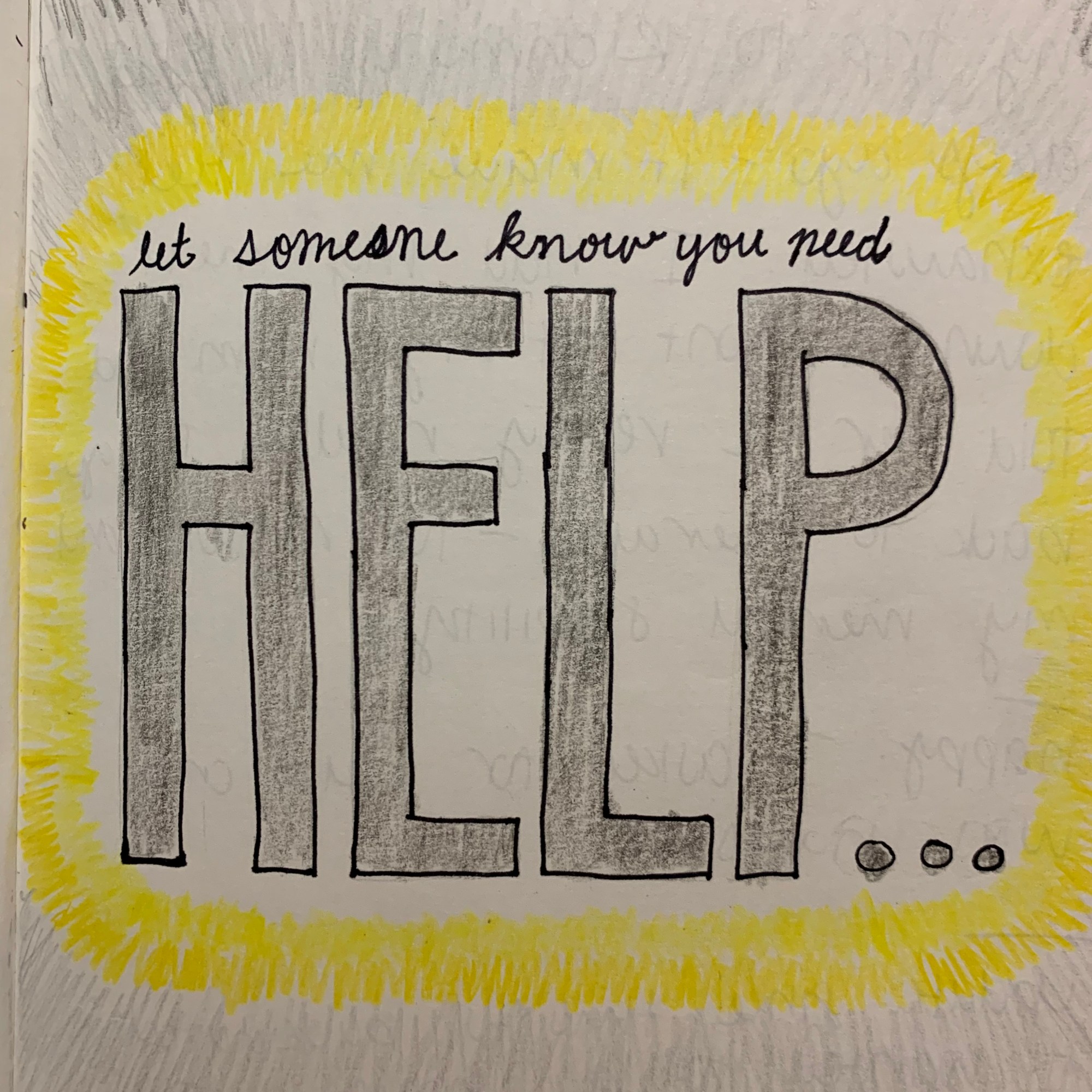
Can we please appreciate that the last journal I illustrated was “Let someone know you need help” and I wouldn’t go to therapy for another eight months? I couldn’t have planned a better character arc.

On this World Mental Health Day, I want to say I am so proud of where I came from, and I’m even more proud of where I’m going.

How to Get a Therapist

So now that you know why I’m in therapy, you might be wondering more about the process of how I found my therapist. How do you get from deciding to go to therapy, to sitting in a therapists office?

My preferred method is a lot like online dating. I like using Psychology Today, which shows you all the nearby therapists who have availability for new clients. You can search by zip code, their specialities, and their accepted insurance. You can even sort the therapists by their sexualities, genders, and faiths. As a bonus, therapists often include a bio of their experience, philosophies, and their preferred therapeutic approaches.

And just like with online dating–you get to make judgements about the qualities and talents of people based solely on their profiles.

I narrowed my search to therapists who specialized in “anxiety” and “depression,” and I got to judging. All male therapists were dropped immediately. Sorry, guys–I knew I’d feel more comfortable with a woman. Then all the younger therapists got the axe. I wanted someone with many years of experience and wisdom; the kind that only comes with age. Being older also increased the chances that my therapist would have grown children, which I secretly wanted because I felt like I needed to hear the perspective of parent who wasn’t my own (even though therapists typically don’t share that type of information with their patients). My final criteria was that my future therapist looked happy and friendly in their profile picture. I was depressed and feeling closed off; I needed someone warm and welcoming.

After some major cuts, I got to reading the bios. I nixed anyone who didn’t specialize in young adults, and then I dropped the therapists whose bios lacked personal flair–I needed to know the therapist had a personality as big as mine.

Some of you may be thinking I spent an inordinate amount of time looking for a therapist to the point of being obsessive. To which I say, yes, you are kind of right. But that doesn’t matter, because I was doing what was best for me at that time. And if it took scrutinizing therapists for several hours to get me to the therapy I so desperately needed, then so be it. I had to pick the right therapist on the first try. I was so exhausted from my depression and so fed up with my emotions that if I picked the wrong therapist, I knew it would take me several more months to renew my willpower to find another therapist. I couldn’t risk picking wrong because I couldn’t stand the thought of staying depressed a second longer.

Once you pick your chosen therapist, there is one final step: the phone call. Therapists typically ask to speak with you on the phone to learn more about you and why you want to go to therapy to ensure you will be a good fit for the them. It honestly feels like a first date. Will they like me? Do they think we’ll be compatible? I like them so much I hope they feel the same way.

I called my therapist of choice, the phone rang through, and her pre-recorded voice prompted me to leave a voicemail.

*Beep*

“Hi, my name is Olivia Vinkler, and…” the tears started to build as I hesitated, “I think I’m depressed?”

I began to cry, “I graduated from college about a year ago, and I haven’t really felt any true satisfaction with my life for a while.” Ouch; hadn’t really said that out loud before.

More tears. “I think I’m just dealing with regular, young adult stuff. Just feeling overwhelmed with post-grad life, living with parents, stress of work. You know, normal stuff.” But I knew the way I was feeling wasn’t my normal.

I tried to catch my breath, but couldn’t, so I choked out the rest of my message as best as I could: “And, I, uh, definitely don’t feel like myself and I would really like to not feel this way anymore. Hope you can help me. Thanks.”

A few hours later, she called me back. I saw her number come through on my caller ID. I ran to my room and shut the door.

“Hi, Olivia. This is [insert therapist’s name], I got your message. Is now a good time?”

“Yeah, now is great!” I chirped, a little too confident. Instant tears. “Sorry, I’m a crier,” I sniffed.

“It’s okay,” the therapist said, “tell me what’s been going on.”

So I did. I told her about the blow out fight with my parents, my frustration at work, my feelings of stagnation. I told her how I hadn’t felt like myself for over a year. I told her how I never had energy, and how I could hardly bring myself to do any of the things that would make me feel better. How I felt disinterested in my own life. I poured my heart out to her, and bless her for being able to understand me through my tears.

The more I poured out, the lighter I felt. While I had been honest with my loved ones that I was depressed, I hadn’t shared everything that was gnawing away at me. It felt incredible to be able to tell this voice on the phone everything that had been weighing me down, to finally put it all out into the open.

“Well, Olivia,” my therapist began.

I held my breath. Just because you choose someone to be your therapist, doesn’t mean they’ll chose you to be their patient. Again, it’s like dating. Imagine opening yourself to someone, only for them to tell you that while you are lovely, they just don’t feel the same connection you do. “You are a wonderful person, and I think you need to get help, too. But it’s not you, it’s me. You belong with someone else.”

“How does this Wednesday sound for our first session?” Fortunately for me, I wouldn’t have to find someone else.

Precipitating Event

I went back to therapy about two months ago.

Very few people decide to go to therapy for the hell of it. Most people experience a triggering event–a death of a family member, the end of a relationship, a traumatic experience, etc.–that causes them to seek help. This event is known as the precipitating event. For me, my precipitating event was a particularly nasty argument with my parents. I was misplacing and projecting all my frustration onto them, and I was emotionally exhausted. I knew it was time to go back to therapy.

While the precipitating event gets a person to therapy, it’s normally not the reason the person stays in therapy. The real reason is often buried deep inside; possibly something not even consciously known. For me, though, the was no hiding why I was going back: I was still depressed, and my mood was deeply and negatively impacting every aspect of my life.

For the last year, and despite making great strides in my mental health, I have not felt like my true, whole self. Being depressed feels like living life as a your own shadow. Your shadow moves like you, and looks like you, but it’s not you. You feel flat; dark; inconsequential–you’re there, but you’re not there. Moving through your own life–not affecting it.

Now after a couple weeks in therapy, I’m feeling significantly better. It’s amazing how much can change when you spend an hour a week actively working with a professional who is trained to literally rewire your brain. I’m no where near where I want to be, and that’s okay, because that’s the point of therapy. You get where you need to go, at your own pace, with your therapist’s guidance.

In one of my first therapy sessions, I told my therapist about this blog. I told her how I started it in 2018, on World Mental Health Day, to raise awareness for depression and anxiety. I told her how I so desperately wanted to write on the blog not just as a form of therapy, but also to hone my writing skills. I told her how my dream was to build the blog to a point where creating content could be my full time job. And then I confessed how I had, quite literally, written absolutely nothing since the first post.

Until today.

Of the many things I’m working on in therapy, one is creating small, realistic, attainable goals that eventually come together to help me reach my larger goals. One small goal I made for myself was to write at least once a week. “But,” I told my therapist, “how will I come up with something to write once a week? I’ll have to find a day that I’m in a really good mood to write, because otherwise I won’t be motivated enough to write.” My therapist told me that was my depression letting me make excuses. But what would I write about every single week?

Conveniently, there is something that happens once a week that always generates great content and normally puts me in a good enough mood to write: therapy.

The Therapy Thoughts section on my blog is going to be a weekly post where I discuss what I’ve talked about in therapy. Writing practice for me, free therapy and insight for you. I’m excited to record my journey through therapy, and I’m excited to see how my therapy will positively change me. I’m sick of not being my whole self.

Here’s to starting (again)!

A to B

You know the feeling you get when you tip yourself too far back in your chair? It’s that falling sensation; your heart stopping; your arms reaching out to grab whatever they can to prevent you from toppling over. Our body’s response to almost falling out of our chair is an example of one of the many reflexes the human body has developed over thousands of years of evolution.

These involuntary, rapid muscular responses to stimuli are actually controlled by the spinal cord, not the brain. The reason is for the sake of speed. For example, when you touch a scorching pan handle, the nerves in your hand send signals to your spinal cord, which then sends a message to the muscles in your hand to contract and pull away from the hot handle. If the muscles in your arm had to send these signals all the way to the brain (a relatively long distance), which then had to send a response signal all the way back, you’d have a nice third-degree burn on your hand by the time your muscles released the hot handle. This is obviously a gross oversimplification of the complexities of the central nervous system, but the main point is this: reflexes exist to protect the body, and sometimes the body is better at protecting itself than the brain would be.

About a year and a half ago, I was living like I was almost always about to fall out of my chair. It was overworked at school, was way over-committed in my extracurricular activities, and I was stifling the feelings of loss and anger that come after a break up. I did not get nearly enough sleep, I did not have enough money, and I was always on edge. It was bad enough that I was always overwhelmed, yet never so bad that I couldn’t figure out a way to get by.

I told myself I’d get myself back together; I just needed some time. I just needed to make it to winter break and then I’d have over a month to catch up. But winter came and went, and I had done nothing to right myself. “That’s okay,” I thought, “I just have to make it to spring break.” Spring break came and went–it still wasn’t better. “It’s all good,” I told myself, “you’ve got the summer to get yourself back in order. Then you’ll be fine.” Summer came and went; and surprise surprise–I was worse. I kept telling myself I just needed a little more time, a little less work, just one more weekend of good sleep, and then I’d be all better. But deep down I knew that wasn’t true. I was depressed, and I needed help.

Everyone’s experience with depression is different, and depression can manifest itself in many ways. My depression is like a slow leak in a pipe. As water trickles out, I think, “I should fix that. It’s a small issue now, won’t take me long.” But then I can’t motivate myself to do it, and I figure I’ll tackle the issue another day. However, when I come back, there is now a puddle of water on the ground. “Crap,” “I think, “this is getting worse, I really should do something. All I have to do is fix the small problem and quickly wipe up the mess and I’m good to go. Thank goodness it’s not that bad yet.” And yet, I still take no action. Soon, the water is up to my knees, then my neck, and then drowning me. Like a reflex, my depression bypasses the self-awareness in my brain, and tries to protect my me by shielding my ego from the fact that I am hurting myself.

Around this time last year, I made my first effort to fix the pipe; to override my reflexes; to let myself fall and get back up: I went to therapy. I spent the first session sobbing, releasing all the negativity that had been weighing on me for over a year. My therapist told me that she empathized with me; that anyone experiencing what I had would feel at least a little depressed. She told me I couldn’t rid myself of my depression overnight, but being in therapy was a good start.

Having a good start was crucial to me because I have a really hard time beginning things. I’m impatient. I’m a perfectionist. I like to know all the information possible before making a decision. I used to tell my therapist, “I can do B to Z, I just can’t do A to B.” I agonize over A to B because that’s the commitment; the acknowledgement you don’t know all the answers, that you’re going to have to learn on the fly, and that things will change and evolve as time goes on. And I hate that. But I’m getting better.

During one of my last therapy sessions, my therapist and I talked about how I planned to continue healing my mental state after I graduated. I had mentioned before that I had wanted to start my own blog, and she thought this was a great idea. It would allow me to authentically share my story, to use my communication skills, and possibly create something that would have a positive impact on others. For the first time in a long time, I was motivated.

But I underestimated the anxiety my lingering depression would cause me. I put off the blog at first because I didn’t know which site to use to publish it. I bought classes to teach me how to start a blog, but neglected to watch them. I tried to reinvigorate myself by designing a logo, but I couldn’t decide on which one I liked best, so I gave up. My pipe was slowly leaking again, and I couldn’t bring myself to begin to patch it back up.

This post is my start. Today, on World Mental Health Day, during Mental Illness Awareness Week, I am choosing to begin; to actively be better–hence, the name of my blog. Originally, I planned to launch this blog five months ago, with a beautifully designed layout, and weeks of content already written. I wanted to produce a podcast with it. I’ve barely edited this post; it’s not perfect. And that’s all okay, because I finally tackled my A to B.

The hardest part is often the very first step. If you are looking for a sign, this was it. If you are struggling with your mental health, confide in someone and get support; go to therapy if you can. To be better at anything, you have to begin.

If you or a loved one need help finding mental health support, click here for some helpful resources.

The National Suicide Prevention Lifeline is 1-800-273-8255.